Amazon PPC
Amazon Product Launch & Ranking
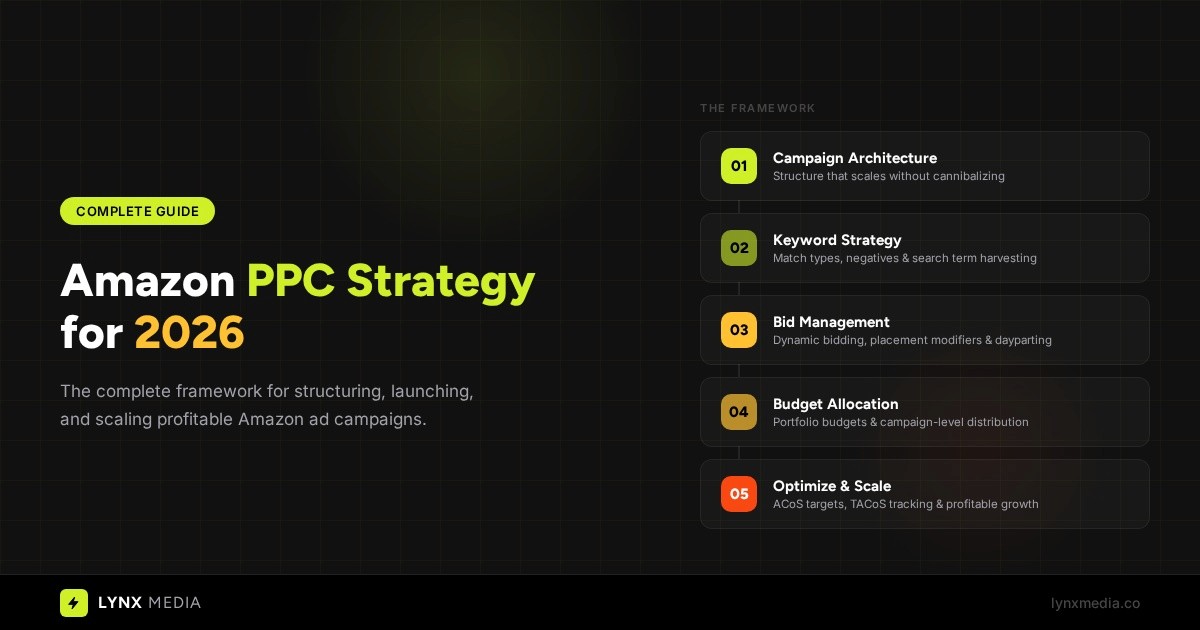
Quick answer: A winning Amazon PPC strategy in 2026 is built on four layers: (1) a campaign architecture that separates discovery from defense, (2) a bid and budget framework tied to your break-even ACoS — not category averages, (3) a listing that converts paid traffic at 12%+, and (4) a weekly optimization loop driven by search term data and placement reports. Sellers who master these four layers typically reduce ACoS 20-35% and grow total revenue 40-80% in the first six months. This guide walks through the full framework we use to manage $29M+ in Amazon ad spend.
Table of Contents
Chapter 3 — Keyword Strategy: Discovery → Qualification → Harvest
Chapter 7 — Launch, Scale, and Defend: Strategy by Lifecycle Stage
Chapter 8 — Advanced Plays: DSP, Sponsored TV, Rufus-Aware PPC
<a id="why-harder"></a>
Why Amazon PPC Is Harder in 2026 Than It Was in 2024
If your Amazon PPC playbook still looks like it did two years ago, you're losing money you can't see.
Three structural shifts have made Amazon PPC materially harder since 2024:
1. CPC inflation outpacing sales growth. Top-of-search CPCs have climbed 25-40% in most categories. The top 10% of bidders in any keyword auction are agency-managed or using AI bidding tools. If you're running manual bids against automated opponents, you're not competing — you're subsidizing them.
2. Rufus and AI-driven search. Amazon's Rufus AI assistant is changing how buyers find products. Conversational queries ("best supplement for joint pain for active 50-year-olds") now drive a growing share of discovery, and the listings Rufus surfaces are chosen by semantic relevance, not just keyword match. Your backend keywords, bullets, and A+ content now matter for paid performance, not just organic.
3. The rise of Sponsored TV and Sponsored Display V2. Amazon has aggressively expanded its ad inventory: Sponsored TV, Sponsored Display with audience targeting, Brand Tailored Promotions, Sponsored Brands video. Brands running only Sponsored Products in 2026 are leaving 30-50% of addressable demand on the table.
The brands winning in 2026 have adapted on all three fronts. This guide is how they did it.
<a id="chapter-1"></a>
Chapter 1 — The LynxMedia PPC Operating System
Before any tactic, you need an operating system. We call ours the LynxMedia PPC Operating System and it sits on four layers:
Layer 1 — Listing foundation. If your listing converts at 6%, doubling your ad spend doubles your loss. Fix the listing before scaling ads.
Layer 2 — The economic target. Every SKU has a break-even ACoS derived from its margin structure. That number — not a category average — is your north star.
Layer 3 — Campaign execution. Campaign architecture, bid strategy, budget allocation, creative. This is what most "Amazon PPC guides" cover — but it's only layer 3 of 4.
Layer 4 — The optimization loop. A weekly cadence that harvests data from search term reports, placement reports, and campaign performance and feeds improvements back down the stack.
The mistake most sellers make: they start at layer 3 (tactics) without fixing layer 1 (listing) or defining layer 2 (target). Then they wonder why "the campaigns aren't working." The campaigns aren't the problem. The stack is.
<a id="chapter-2"></a>
Chapter 2 — Campaign Architecture That Actually Scales
Campaign architecture is the single biggest PPC lever nobody talks about. Two accounts with identical budgets and identical products can have 2x different ACoS purely because of how their campaigns are structured.
The three jobs every campaign must do
Every ad dollar in your account is doing one of three jobs:
Discovery — finding new converting search terms (exploration)
Harvest — scaling proven search terms (exploitation)
Defense — protecting branded queries and high-intent terms from competitors
Most accounts we audit have all three jobs mashed into the same campaigns. That's why their data is unreadable and their ACoS is volatile.
The fix: separate campaigns by job. One campaign, one job. Read the data at the campaign level.
The LynxMedia 3-Tier Architecture
This is the structure we deploy on every new account. It's boring and it works.
Tier | Campaign Type | Match Type | Job | Target ACoS |
|---|---|---|---|---|
Tier 1 — Discovery | Sponsored Products Auto + Broad Manual | Auto, Broad | Find new converting keywords | Category break-even |
Tier 2 — Harvest | Sponsored Products Exact Manual | Exact | Scale proven winners | Target ACoS (break-even − 12) |
Tier 3 — Defense | Sponsored Brands + Sponsored Products on branded terms | Exact / phrase | Block competitors on your brand | ACoS is irrelevant — track impression share |
How the tiers feed each other
The tiers are not independent. They form a harvest waterfall:
Every week, search terms that cross a conversion threshold in Discovery get promoted to an Exact Harvest campaign with a higher bid and a tighter ACoS target. Then they're added as negatives in the Discovery campaign so you're not paying twice for the same traffic.
This one mechanic — the harvest waterfall — is the difference between a PPC account that gets cheaper over time and one that gets more expensive.
Campaign naming convention (do this from day one)
Boring, strict, consistent. When you have 200+ campaigns across 30 SKUs, naming is the difference between readable data and a dumpster fire.
<a id="chapter-3"></a>
Chapter 3 — Keyword Strategy: Discovery → Qualification → Harvest
Most Amazon PPC "keyword strategy" advice is just "do keyword research with Helium 10." That's not a strategy. That's a tool.
Keyword strategy is about building a pipeline — a system that turns raw search terms into qualified keywords and qualified keywords into harvest campaigns. Here's ours.
Stage 1 — Seed
Start with 30-50 seed keywords per SKU. Sources, in priority order:
Your top 10 organic-ranking search terms (from Brand Analytics or Seller Central search query performance)
Your top 10 competitor listings' ranked keywords (Helium 10 Cerebro or Jungle Scout reverse-ASIN)
Amazon's auto-complete (Amazon Search Bar, Amazon Suggested Expander)
Product category's high-volume head terms (be careful — these are expensive)
Long-tail variants (4+ word phrases)
Stage 2 — Discovery (auto + broad)
Load the seeds into a Discovery-tier campaign (auto targeting + broad match manual). Let it run for 7-14 days. Collect search term data. Goal: quantity, not efficiency. Expect ACoS to be ugly here. That's fine — you're buying data, not sales.
Stage 3 — Qualification
Pull the search term report every Monday. Every search term falls into one of four buckets:
Bucket | Criteria | Action |
|---|---|---|
Winners | 2+ orders AND ACoS ≤ target | Promote to Exact Harvest |
Watchlist | 1 order OR ACoS between target and break-even | Keep running, watch for 7 more days |
Losers | 10+ clicks, 0 orders | Add as negative exact in Discovery |
Irrelevant | Wrong product / wrong intent | Add as negative exact everywhere |
Stage 4 — Harvest
Promoted winners go into Exact match campaigns with tighter bids and tighter budgets. These are your profit engines. This is where the tight ACoS lives.
Stage 5 — Expansion
Once you have 20+ harvested winners, look for patterns:
All your winners share a modifier word ("organic," "travel-size," "for men") → launch a new broad-match Discovery campaign around that modifier
All your winners target a specific customer persona → test Sponsored Display with audience targeting at that persona
All your winners cluster in a specific category node → test category targeting in Sponsored Display
Keyword strategy is a loop, not a one-time task. Every week, you're seeding, discovering, qualifying, harvesting, and expanding.
<a id="chapter-4"></a>
Chapter 4 — Bidding, Budgets, and the Break-Even Framework
This is where most sellers lose money. Not because they bid too high or too low, but because they bid without a framework.
Step 1 — Calculate break-even ACoS per SKU
Every SKU has its own break-even ACoS:
Break-Even ACoS = (Gross Profit ÷ Selling Price) × 100
Worked example for a $50 SKU:
Line item | Amount |
|---|---|
Selling price | $50.00 |
COGS | −$15.00 |
FBA fulfillment | −$7.50 |
Amazon referral fee (15%) | −$7.50 |
Returns / storage / shrink | −$2.00 |
Gross profit | $18.00 |
Break-even ACoS = ($18 ÷ $50) × 100 = 36%
Step 2 — Set target ACoS with profit buffer
Target ACoS = Break-Even ACoS − 10 to 15 points
In this example: 36% − 12 = 24% target ACoS.
The buffer absorbs returns, organic cannibalization, and CVR volatility. Without it you're running the SKU at razor-thin profit.
Step 3 — Translate target ACoS to a starting bid
Starting bid = Price × CVR × (Target ACoS ÷ 100)
Worked example: $50 product, 10% CVR, 24% target ACoS:
Starting bid = $50 × 0.10 × 0.24 = $1.20
That's your data-driven starting bid for any new keyword. It's not a guess — it's math that keeps you at target ACoS if your CVR holds.
Step 4 — Budget allocation by tier
Total PPC budget should split roughly like this:
Tier | % of total budget | Purpose |
|---|---|---|
Discovery | 20-30% | Finding new winners |
Harvest | 55-65% | Scaling winners at target ACoS |
Defense | 10-15% | Protecting branded terms |
Experimental (DSP, STV, SD) | 5-10% | Testing new ad types |
A common mistake: sellers put 90% of budget into Sponsored Products Exact on a short list of keywords, starve Discovery, and then wonder why their account stops growing. Discovery is not optional — it's the only source of future winners.
Step 5 — Bid adjustments by placement
Amazon lets you modify bids by placement (Top of Search, Rest of Search, Product Pages). Pull the Placement Report monthly and set modifiers based on where the conversions actually happen. Top-of-Search conversions are worth significantly more in most categories — a +50% to +100% modifier there is often the right answer, but only where the data supports it.
<a id="chapter-5"></a>
Chapter 5 — The 5 Ad Types and When to Use Each
In 2026, Amazon offers five paid formats that matter. Most sellers use two. That's why most sellers leave money on the table.
1. Sponsored Products (SP)
What it is: The default ad you see in search results and on product pages. Keyword and product targeting.
When to use it: Always. SP should represent 60-70% of your total PPC budget. This is the workhorse.
Pro tip: Run Sponsored Products with both keyword targeting (for search intent) and product targeting (targeting competitor ASINs). These are two different jobs and should live in separate campaigns.
2. Sponsored Brands (SB)
What it is: Banner ads at the top of search results featuring your brand logo, a custom headline, and 3 products. Video and Store Spotlight variants available.
When to use it:
Branded defense on your own brand name (non-negotiable if you have Brand Registry)
High-intent category head terms where you want to occupy top-of-search real estate
Driving traffic to your Amazon Store page for portfolio selling
Pro tip: Sponsored Brands Video is dramatically under-used. Video placements convert 2-3x better than static SB ads in most categories we've tested. If you have product demo footage, run it.
3. Sponsored Display (SD)
What it is: Display ads that run both on and off Amazon. Two targeting modes: Product targeting (ASINs and categories) and Audience targeting (views, purchases, interests, lifestyle).
When to use it:
Product targeting: Defending your own product detail pages and attacking competitor PDPs
Audience targeting: Retargeting buyers who viewed your product but didn't buy; prospecting to lookalike audiences
Pro tip: SD "Views Remarketing" is one of the highest-ROI campaign types on Amazon. You're paying to re-engage people who already showed intent. Run it on every SKU with 1,000+ monthly detail page views.
4. Sponsored TV (STV)
What it is: Amazon's streaming TV ads running on Prime Video, Freevee, Fire TV, and Twitch. Launched broadly in 2024-2025, now a real channel in 2026.
When to use it:
Upper-funnel brand awareness for established brands (not launches)
Category expansion when you want to capture demand before people search
Brands with video assets and a 7-figure+ annual ad budget
Caveat: STV is not a direct-response channel. Measure it on New-to-Brand rate and TACoS lift, not ACoS. If you don't have the budget to run it for 90+ days, don't start.
5. Amazon DSP (Demand-Side Platform)
What it is: Programmatic ad buying across Amazon's owned-and-operated inventory and third-party sites. Audience-first, not keyword-first.
When to use it:
8-figure brands building full-funnel strategies
Category conquesting (buying audiences from competitor categories)
Retargeting at scale with advanced audience segmentation
Caveat: DSP has historically required $35K+/month minimums (though self-serve options exist in 2026). It's not for everyone.
The 5-ad-type budget blueprint (for a scaled brand)
Ad type | % of PPC budget | ACoS target |
|---|---|---|
Sponsored Products | 60-65% | Target ACoS |
Sponsored Brands | 10-15% | Target ACoS + 5 |
Sponsored Display (retargeting) | 10-15% | Target ACoS − 5 |
Sponsored Display (prospecting) | 5-10% | Category break-even |
Sponsored TV / DSP | 5-10% | Measured on New-to-Brand, not ACoS |
<a id="chapter-6"></a>
Chapter 6 — The Weekly Optimization Loop
This is where amateur PPC becomes professional PPC. The best account managers we know run the same five-check loop every Monday on every account.
The 5-check Monday loop
Check 1 — Search term report review (30 min per SKU)
Export last 7 days of search term data
Promote winners to Harvest, negate losers, flag watchlist
Output: updated negative keyword lists and new Exact campaigns
Check 2 — Bid adjustments on harvest campaigns (15 min)
Any keyword with ACoS > target for 2+ weeks → reduce bid 10-15%
Any keyword with ACoS < target AND impression share < 80% → increase bid 10-15%
Output: bid sheet updated
Check 3 — Budget pacing (10 min)
Any campaign hitting budget cap by 2pm → increase budget 20%
Any campaign spending <50% of budget → diagnose (usually bid too low)
Output: budget reallocation
Check 4 — Placement report review (biweekly, 20 min)
Adjust Top-of-Search / Rest-of-Search / Product-Pages bid modifiers based on where conversions actually happen
Output: placement modifiers updated
Check 5 — TACoS and hero SKU health (15 min)
Is TACoS trending down? (healthy organic lift)
Is any hero SKU's organic rank slipping? (defend with more PPC)
Any SKU with falling CVR? (listing problem, not a PPC problem — escalate to listing team)
Output: flagged SKUs for the week
Total: ~90 minutes per SKU per week, or 3-4 hours per 5 SKUs with a clean account. That's the rhythm of a healthy account.
What not to do on Mondays
Don't restructure campaigns. Restructuring is a monthly or quarterly decision.
Don't launch new ad types. New ad type tests happen on planned cycles.
Don't over-optimize single keywords. Look at the portfolio, not the outlier.
<a id="chapter-7"></a>
Chapter 7 — Launch, Scale, and Defend: Strategy by Lifecycle Stage
The single biggest PPC mistake we see is applying a mature-SKU playbook to a launching product. Different lifecycle stages need completely different strategies.
Stage 1 — Launch (Days 0-90)
Goal: Buy ranking, reviews, and velocity — not profit.
Accept 40-60% ACoS. You're buying data and rankings, not sales.
Budget: $30-100/day/SKU depending on price point and category
Focus ad types: Sponsored Products Auto + Broad (maximum discovery), Sponsored Brands Video for awareness
Track: review velocity, BSR climb, organic rank for target keywords — not ACoS
Use Amazon Vine aggressively to build review count
Expect: lots of "bad" data. The first 30 days are noise. Don't over-optimize.
Stage 2 — Scale (Days 90-270)
Goal: Ramp organic share while keeping ACoS trending toward target.
Rebuild campaign structure into the 3-Tier architecture if you haven't already
Start harvesting winners aggressively
Watch TACoS more than ACoS — falling TACoS with flat ACoS = organic is growing
Begin testing Sponsored Display retargeting
Expand into adjacent keyword themes
Stage 3 — Mature / Defend (Day 270+)
Goal: Profitability, brand defense, efficiency.
Run at target ACoS (break-even − 12)
Maintain branded defense campaigns — these look inefficient on ACoS but stop hijackers
Test Sponsored TV / DSP if you're at scale
Monitor for competitor attacks — sudden CPC spikes on your branded terms usually mean someone just bought your brand name
Stage 4 — Decline / Refresh
Goal: Decide whether to reinvest or harvest.
If sales are declining but margin is intact: run efficiency-only PPC (harvest only, no discovery)
If you're refreshing the product: treat it as a new launch and reset
If you're sunsetting: cut PPC budget entirely and let organic tail run out
The lifecycle-by-ACoS table
Stage | Target ACoS | Primary metric | Ad type mix |
|---|---|---|---|
Launch (0-90d) | 40-60% | Review velocity, BSR | SP Auto + Broad, SB Video |
Scale (90-270d) | 25-35% (falling) | TACoS trend | Full 3-tier, +SD retargeting |
Mature (270d+) | Target (break-even − 12) | Net profit, impression share | Full 5-ad-type blueprint |
Decline | Efficiency-only | Margin | SP Exact harvest only |
<a id="chapter-8"></a>
Chapter 8 — Advanced Plays: DSP, Sponsored TV, Rufus-Aware PPC
For brands already running a clean 3-tier architecture with a profitable harvest waterfall, here's where the next 10-20% of growth comes from.
Play 1 — Full-funnel with Sponsored TV
Sponsored TV is Amazon's answer to linear TV advertising, running on Prime Video, Freevee, Fire TV, and Twitch. For brands at $1M+/month Amazon revenue, STV can drive a 5-15% TACoS lift in 90 days by feeding top-of-funnel awareness into the existing bottom-of-funnel PPC stack.
Measure it on New-to-Brand purchase rate, not ACoS. Expect a 60-90 day ramp before the lift shows.
Play 2 — DSP retargeting at scale
Amazon DSP's audience targeting lets you retarget:
Pixel viewers — people who viewed your detail page but didn't buy
Category viewers — people browsing your category
Competitor purchasers — people who bought a competitor's product (lookalike audiences)
DSP retargeting typically runs at 2-3x the ROAS of Sponsored Display retargeting for 8-figure brands, but requires minimum spend commitments and a dedicated manager.
Play 3 — Rufus-aware listing optimization
Amazon Rufus (the AI shopping assistant) is quietly changing what "search relevance" means on Amazon. Rufus uses semantic understanding of your listing content — title, bullets, A+ content, even Q&A — to decide which products to recommend in conversational queries.
What this changes for PPC:
Backend keywords are losing weight; natural language in bullets and A+ is gaining weight
Your listing's relevance to conversational queries ("best supplement for a 50-year-old runner") now affects paid performance, not just organic
A+ content written in natural, benefit-driven language outperforms keyword-stuffed content for both organic and paid CVR
The takeaway: your listing team and your PPC team need to be working from the same playbook. In 2026, they're no longer separate functions.
Play 4 — Brand Tailored Promotions as a PPC feeder
Amazon's Brand Tailored Promotions let you send exclusive discount offers to specific audience segments (cart abandoners, brand followers, repeat buyers). This isn't PPC in the traditional sense, but it integrates into the funnel — BTP converts the lower-funnel audiences that PPC generated into repeat customers, pushing LTV up and effectively lowering your CAC across every ad type.
<a id="chapter-9"></a>
Chapter 9 — The Metrics That Actually Matter
If you track 30 metrics you track nothing. Here are the 7 that actually drive decisions.
Metric | What it tells you | Cadence |
|---|---|---|
ACoS | Per-campaign efficiency | Weekly |
TACoS | Brand health — is organic growing? | Weekly |
CVR | Listing health | Weekly |
CTR | Creative / placement health | Weekly |
Impression share | Competitive position | Weekly |
New-to-Brand % | Upper-funnel effectiveness | Monthly |
Net profit per SKU | The one that actually matters | Monthly |
If you only track one number: track net profit per SKU. ACoS is a proxy. Net profit is the thing ACoS is a proxy for. Never forget the direction of that relationship.
TACoS > ACoS for brand health. Any account where TACoS is falling while revenue is growing is a healthy account, regardless of what ACoS looks like on any given campaign.
<a id="mistakes"></a>
Common Mistakes We See on 7-Figure Brands
Five patterns that show up on nearly every account we audit:
Mashing discovery and harvest into the same campaign. The data becomes unreadable. Separate them.
Ignoring branded defense because "ACoS looks too low to matter." Brand defense is insurance, not performance. Pulling it invites hijackers.
Over-optimizing on single keywords. Optimize the portfolio; outliers are noise.
Launching with a mature-SKU ACoS target. Launches need ugly ACoS. Measure ranking, not efficiency.
Treating the listing as the listing team's problem. Half of ACoS lives in CVR, and CVR lives on the listing. PPC and listing optimization are one job now.
<a id="faq"></a>
Frequently Asked Questions
What is a good Amazon PPC strategy for 2026? A good Amazon PPC strategy in 2026 separates campaigns by job (discovery, harvest, defense), sets bids based on break-even ACoS (not category averages), uses all five ad types in a deliberate mix, and runs a weekly optimization loop driven by search term and placement reports. The framework in this guide — the LynxMedia PPC Operating System — is the structure we use to manage $29M+ in Amazon ad spend across 7-8 figure FBA brands.
How much should I budget for Amazon PPC? Most scaling FBA brands spend 8-15% of Amazon revenue on PPC. Launches can temporarily hit 25-40%. Mature brands with strong organic can drop to 5-8%. Start with 10% of revenue as a baseline and adjust based on lifecycle stage and TACoS targets.
How long does Amazon PPC take to work? Expect 30 days of noise, 60-90 days of visible improvement, 6 months for steady-state. Search term harvesting compounds — month 6 is dramatically more efficient than month 1 on the same account.
Should I use Amazon's automated bidding or manual bids? Use both. Run Sponsored Products Auto campaigns for discovery (they're Amazon's best tool for finding new search terms) and Manual campaigns with Exact-match bids for harvest. The harvest waterfall between them is where the profit lives.
What's the difference between Sponsored Products, Sponsored Brands, and Sponsored Display? Sponsored Products target individual search terms or ASINs and run as in-line results — the workhorse of Amazon PPC. Sponsored Brands are banner ads featuring your brand logo, custom headline, and multiple products — best for top-of-search and branded defense. Sponsored Display targets audiences (including off-Amazon) — best for retargeting and competitor conquesting.
How do I lower ACoS without cutting spend? Five proven levers: weekly negative keyword hygiene, lift listing CVR, shift budget toward long-tail keywords, use placement bid modifiers, and A/B test Sponsored Brands creative. Most brands reduce ACoS 10-30% in 60 days without changing total spend. See our full guide to what a good ACoS on Amazon looks like.
Should I manage PPC in-house or hire an agency? If you're below $500K/month on Amazon and have 10+ hours a week to dedicate to PPC, in-house is viable. Above $500K/month, the complexity (full 5-ad-type stack, multiple SKUs, weekly optimization cadence, Rufus-aware listing work) usually exceeds what an in-house generalist can maintain. The break-even point depends more on your time than your spend.
What's the relationship between Amazon PPC and organic rank? PPC drives sales velocity on your target keywords, and sales velocity is one of Amazon's strongest organic ranking signals. This is why launch PPC is so important — you're not just buying ad-driven sales, you're buying organic ranking. A well-run PPC campaign lifts organic rank for its target keywords within 60-90 days.
How does Amazon Rufus change PPC strategy? Rufus uses semantic understanding of listings to answer conversational queries. That means listings written in natural, benefit-driven language — rather than keyword-stuffed bullets — now perform better on both organic and paid traffic. In 2026, your listing optimization and PPC strategy are no longer separate disciplines.
The Bottom Line
Amazon PPC in 2026 isn't about finding the one clever tactic. It's about running a disciplined system:
A listing that converts (layer 1)
A break-even target you actually calculated (layer 2)
A 3-tier campaign architecture that separates discovery from harvest from defense (layer 3)
A weekly optimization loop that feeds data back into bids and budgets (layer 4)
Sellers who run this stack consistently grow revenue 40-80% and reduce ACoS 20-35% in the first six months. Sellers who don't run it spend the same money and wonder why the numbers don't move.
If you'd rather have someone run this system for you across $29M+ in managed ad spend experience — book a free Amazon PPC audit with LynxMedia. We'll analyze your campaign structure, calculate break-even ACoS on your top 10 SKUs, and show you exactly where the 20-35% improvement is hiding in your account.