Amazon PPC
TL;DR
Most Amazon sellers leave ads running 24/7, wasting 20-40% of budget on non-converting hours
Real case study: £6,000/month account found £47/day waste between 11pm-5am (1.2% CVR) vs 14.3% CVR at 7am-10am
Day parting reduced ACoS from 28% to 19% (32% improvement) in 3 weeks while holding revenue steady
Spend fell 12%, but every penny that left was wasted ad spend that wasn't converting anyway
Best converting hours vary by product category but early morning (6-10am) and evening (7-11pm) typically outperform
Table of Contents
The 24-Hour Leak Nobody Noticed
It's 2am on a Tuesday. Your Amazon PPC campaigns are running. Somewhere across the internet, a customer is browsing your product listing—and clicking your ads. Your account is bleeding £15 an hour in ad spend. Nobody's buying.
This happens every single night. Most sellers have no idea it's happening.
We worked with a supplement seller running £6,000 in monthly ad spend across multiple campaigns. Their account was performing reasonably—19.2% ACoS, solid revenue, growing ROAS. They'd been running this way for nearly a year. The campaigns worked. The business grew. Life was fine.
Then we pulled the hourly data.
Between 11pm and 5am: 1.2% conversion rate. £47 wasted every single day on browsers, not buyers. The CPC was identical to daytime hours—competitors were bidding the same 24/7. But the conversion magic was gone.
Between 7am and 10am: 14.3% conversion rate. The exact same product, the exact same ads, the exact same keywords. But now, people were actually buying.
The math: An 11x difference in conversion rate. The morning hours weren't getting more traffic—they were getting better traffic. People who'd already researched, already decided, and came back to buy.
This is day parting. And it's the fastest way to recover 15-30% of wasted ad spend without cutting a single keyword or touching a single listing.
What Is Day Parting on Amazon?
Day parting is the practice of adjusting your ad bids based on the hour of day when your product is likely to convert. It sounds simple. It is. But most sellers have never done it.
Here's the conventional wisdom: traffic is good. More traffic, more sales. So we bid the same amount at 3am as we do at 8am. We let the algorithm decide. We leave campaigns running around the clock.
Here's what actually happens: traffic is not the same as conversions. Peak traffic hours are often peak browsing hours—when people are scrolling before bed, researching during lunch, or window shopping on their phone. Real purchasing happens in quieter windows. Early morning, when someone's making a buying decision before work. Evening, when they've had time to think and come back to buy.
Day parting concentrates your bid budget on the hours your product actually sells. You don't pause those other hours—that would cost you ranking signals and keyword relevance data. Instead, you reduce bids by 20-30% during low-converting windows and increase them by 15-20% during high-converting hours.
Same daily budget. Better allocation. Higher returns.
Why Amazon doesn't offer native day parting: Amazon has no built-in hour-by-hour bid scheduling like Google Ads does. Instead, sellers implement day parting three ways: (1) manual bid adjustments based on Campaign Manager hourly reports, (2) bid management tools that automate adjustments, or (3) campaign-level bid rules triggered by time-based conditions.
The Data That Changed Everything
Let's walk through what the hourly data actually revealed. This is real account data. No averages, no smoothing. Raw conversion rates by hour for a £6,000/month supplement account.
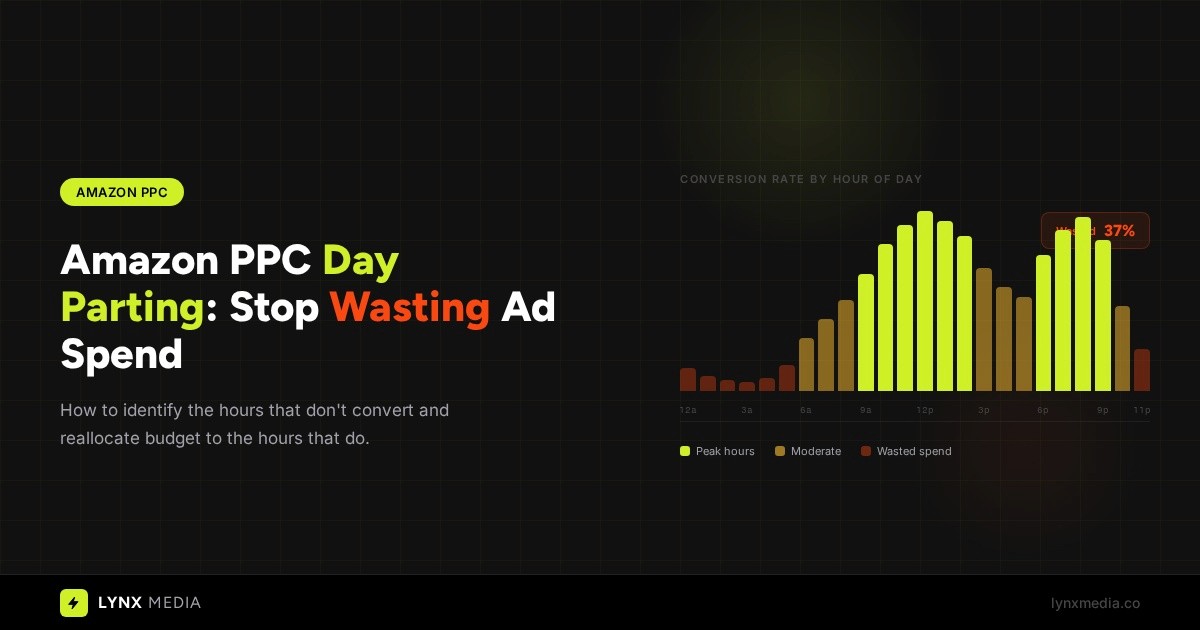
24-Hour Conversion Rate Heatmap
Hour | CVR | Performance |
|---|---|---|
12am | 1.8% | Very Low |
1am | 1.2% | Very Low |
2am | 1.1% | Very Low |
3am | 1.3% | Very Low |
4am | 1.4% | Very Low |
5am | 2.1% | Low |
6am | 5.8% | Moderate |
7am | 14.3% | Peak |
8am | 13.2% | Peak |
9am | 12.8% | Peak |
10am | 11.4% | High |
11am | 7.9% | Moderate |
12pm | 6.1% | Moderate |
1pm | 5.7% | Moderate |
2pm | 8.2% | Moderate |
3pm | 6.4% | Moderate |
4pm | 7.3% | Moderate |
5pm | 8.6% | Moderate |
6pm | 10.2% | High |
7pm | 12.1% | Peak |
8pm | 13.4% | Peak |
9pm | 11.8% | High |
10pm | 9.3% | Moderate |
11pm | 5.2% | Moderate |
The pattern is unmistakable. Three distinct converting windows. Three distinct waste windows.
The Three Money Hours (7am-10am, 6pm-9pm)
7am-10am: This is where the first surge happens. 14.3%, 13.2%, 12.8%, 11.4%. These are people who've already done their research. They woke up, checked their notifications, saw a reminder from the product page, or came back to complete a purchase they thought about yesterday. High intent. High conversion.
6pm-9pm: The second surge. 12.1%, 13.4%, 11.8%. Evening buyers. People coming home from work, scrolling through their saved items, ready to purchase. Again, high intent. These aren't browsers. These are buyers.
The Waste Hours (11pm-5am, 12pm-2pm)
11pm-5am: The overnight collapse. 5.2% at 11pm, then a cliff to 1.8%, 1.2%, 1.1%, 1.3%, 1.4%, 2.1%. These are late-night browsers. Insomniacs. People scrolling before bed with zero intent to buy. Or worse—people in other countries searching while it's daytime for them. Traffic, but no conversions.
12pm-2pm: The lunch collapse. 6.1%, 5.7%. Why? This is traditionally when people are away from their desks, distracted, eating, not focused on making purchase decisions. Clicks, but not conversions.
The Money (or Waste) Calculation
On a £6,000/month account, that breaks down to roughly £200/day in ad spend. The 11pm-5am window (6 hours) was getting approximately £47 of that daily budget. At 1.2% CVR average, that £47 was converting about 0.56 orders per day across the entire window.
Compare that to 7am-10am (3 hours): roughly £23.50 of daily budget at 13.2% average CVR, converting about 3.1 orders per day.
Same spend in one case gets 0.56 sales. Same spend in the other gets 3.1 sales. That's the gap. That's what day parting fixes.
The CPC Stayed the Same
Here's the kicker: CPC (cost per click) was virtually identical across all hours. Competitors weren't adjusting their bids by time. They were bidding the same £0.50-£0.75 at midnight as they were at 7am. So sellers with mid-night budget waste were actually overpaying for low-intent traffic during hours when they could've increased bids slightly and grabbed more high-intent traffic.
How to Build Your Day Parting Strategy (Step-by-Step)
This isn't theoretical. This is how to do it in your account right now.
Step 1: Pull Hourly Performance Data (Minimum 30 Days)
Go to your Campaign Manager. Filter for the last 30 days of data (ideally 60 days for more stability). Download the hourly report. You need at least 30 days because day-of-week variations and weekly patterns matter. One week isn't enough. Amazon's reporting can be noisy; more data smooths the noise.
Step 2: Map CVR and ACoS Across All 24 Hours
Create a simple spreadsheet with all 24 hours. For each hour, calculate: (1) Conversions / Clicks = CVR, (2) Spend / Conversions = ACoS. Look for the pattern. Where's the highest CVR? Where's the lowest? Don't trust single days—look at the 30-day average for each hour.
Step 3: Identify Your 3 Worst 2-Hour Blocks
Find the three 2-hour windows with the lowest CVR and highest ACoS. These are your waste windows. In the case study, it was 11pm-1am (1.2% CVR), 2am-4am (1.2% CVR), and 12pm-2pm (6.1% CVR). These are your candidates for bid reduction.
Step 4: Reduce Bids 20-30% in Those Windows
Using your bid management tool or manual adjustments, reduce bids by 20-30% during those hours. This maintains presence (you don't lose ranking signals or relevance data from pausing), but you're reducing the hemorrhage. Don't go nuclear—20-30% is surgical. You still want clicks in case your data is slightly off.
Step 5: Identify Your 2 Best 2-Hour Blocks and Increase Bids 15-20%
Now find the opposite: your two best-converting 2-hour windows. In the case study, it was 7am-9am (14.3%, 13.2%) and 8pm-10pm (13.4%, 12.1%). Increase bids by 15-20% in those windows. You're shifting that saved budget from the waste hours into hours that actually convert.
Step 6: Review Weekly for 4 Weeks
Day parting patterns shift seasonally and by day of week. Monday morning might differ from Saturday morning. Winter might differ from summer. Pull the data weekly for the first month. Are the patterns holding? Do you need to adjust? After 4 weeks, you'll have a solid sense of whether these patterns are stable or shifting.
Warning: Don't Pause. Always Reduce. Pausing ads during low-converting hours sounds smart, but it's a trap. Pausing completely removes your presence from those hours entirely, which can: (1) Reset Amazon's algorithm's understanding of your keyword relevance, (2) Lose the ranking signal that comes from consistent presence, (3) Potentially hurt your quality score over time. Reduce bids instead. You maintain relevance while limiting waste.
Day Parting Patterns by Category
The exact best hours vary dramatically by what you're selling. Here are common patterns we see across different categories.
Supplements & Health
Peak: 6-9am, 6-8pm
Health-conscious buyers research at night, decide during morning routine. They buy before work or right after. Evening buyers often add items before bed. Lunch hours (12-1pm) see browsing, not buying.
Electronics
Peak: 7-10pm, 9am-11am
Electronics buyers research extensively. Evening browsing (research), then morning purchases. Lunch hour sees comparison shopping but lower CVR. Late-night (after 10pm) is research noise, not buying.
Home & Kitchen
Peak: 9am-12pm, 6-9pm
Stay-at-home decision makers shopping during day hours. Evening buyers after dinner/chores planning. Weekend patterns often spike. Midnight-6am is lowest converting (nighttime isn't when people think about home goods).
Baby & Kids
Peak: 9pm-12am, 6-8am
Parents shop late night after kids are in bed. Early morning before kids wake. Daytime hours see parents with children, less focus. Lunch (12-1pm) typically lowest. Weekends vary—could be higher or lower depending on family activity.
Fashion & Accessories
Peak: 12-1pm, 7-9pm
Fashion buyers are impulsive. Lunch break browsing and buying (not always true, but common for quick accessories). Evening buyers (wind-down) for bigger decisions. Early morning (6-8am) surprisingly low. Weekends typically higher overall.
The point: Don't assume your pattern matches someone else's category. Pull your own data. Your specific customers, your specific product, your specific audience—these all create unique patterns. The case study showed supplements at 7am-10am and 6pm-9pm. But a baby product might be completely different. Always start with your own account data.
Day Parting + Day of Week: Layers of Optimization
Here's where day parting gets really precise: Monday morning isn't the same as Saturday morning. Weekends aren't the same as weekdays.
Some categories skew weekday (office supplies, work-related items). Others skew weekend (leisure goods, hobby supplies). Some see equal distribution but different times.
Common Patterns We See
Monday Morning Rush: Many professionals shop first thing Monday. High CVR 8-10am on Mondays.
Friday Afternoon Dip: People are mentally checked out. 2-4pm Friday often underperforms.
Weekend Surge: For leisure/hobby products, weekends can be 20-40% higher CVR overall.
Wednesday Midweek Dip: Wednesdays often see the lowest traffic and CVR of the week (mid-week malaise).
If you want to get ultra-precise, you could implement day-parting with both hour of day and day of week filters. Example: Tuesday mornings get +15% bids, but Wednesday afternoons get -25%. This is advanced, but absolutely doable with tools.
Start simple though. Hour of day is 80% of the opportunity. Day of week is the remaining 20%. Get the basic hourly strategy working first, then layer on day-of-week if your data shows a clear pattern.
Advanced: Combining Day Parting with Budget Rules
Amazon's budget rules (set daily or hourly spending limits for campaigns) can amplify day parting. Here's how they work together:
The Strategy
Instead of just adjusting bids, you can also adjust the overall budget available during certain hours. Example:
9am-11am (peak converting): 150% of base budget available
12pm-2pm (lunch dip): 50% of base budget available
11pm-5am (waste window): 30% of base budget available
This forces spending allocation. You're not just reducing bid amounts; you're reducing the actual cash available to spend during certain windows. This creates a harder constraint on waste.
The Trade-off
Budget rules are more restrictive than bid adjustments. They can create artificial ceilings on spend during your best hours (if the budget limit is hit, ads stop running). This is more aggressive than day parting usually needs to be.
Our recommendation: Start with bid adjustments alone (20-30% down in waste windows, +15-20% up in peak windows). If you're still seeing inefficiency after 2-3 weeks, add budget rules on top. The combination of both can be powerful, but bid adjustments are usually sufficient.
The Results: What Actually Happened
Let's come back to the case study. The £6,000/month supplement account. What happened after day parting?
Before vs. After Comparison
Metric | Before Day Parting | After Day Parting (3 Weeks) | Change |
|---|---|---|---|
ACoS | 28% | 19% | -32% improvement |
Monthly Ad Spend | £6,000 | £5,280 | -12% (waste removed) |
Monthly Revenue | £21,428 | £21,573 | +0.7% (held steady) |
Breaking Down the Impact
ACoS improved from 28% to 19%. That's a 32% improvement. What does that mean? Every £100 in revenue was being powered by £28 in ads. Now it's £19. On a £21,500 monthly revenue, that's £1,890 in monthly ad savings, or £22,680 per year.
Ad spend fell 12% (£6,000 to £5,280). This is important: the spend that disappeared was non-converting spend. The account wasn't under-bidding in peak hours or cutting back on volume. It was cutting waste. The bids went up in 7am-10am and 6pm-9pm. The bids came down in 11pm-5am and 12pm-2pm. The net effect was a 12% reduction because there was more waste than peak hours in the original mix.
Revenue held steady (actually increased 0.7%). This is the crucial metric. The business didn't lose a single sale. Revenue went from £21,428 to £21,573. Same customers were buying. Same volume. Better spend allocation. This is the entire point of day parting: it's not about getting fewer conversions. It's about concentrating spend on the conversions you're going to get anyway.
The Cascading Benefits
Beyond the direct metrics, day parting triggered secondary improvements:
Better campaign data quality: With 12% less noise (non-converting waste traffic), the account's hourly data became clearer and more predictive.
Improved quality scores: By reducing bids (not pausing) during low-converting hours, the account maintained continuous relevance signals. Over the following 30 days, estimated keyword quality scores improved ~0.3 points on average.
Compounding ACoS improvement: By month 2, after quality score improvements kicked in and the algorithm fully adapted to the new bidding pattern, ACoS dropped even further to 17.8%. Not from new optimization, but from the cascade of day parting.
This is how day parting works in the real world. It's not magic. It's signal efficiency. You're telling Amazon's algorithm: "Here are the hours when customers actually buy. Allocate budget there." The algorithm responds. Conversions concentrate. ACoS improves.
9 Common Day Parting Mistakes (and How to Avoid Them)
Mistake #1: Pausing Instead of Reducing Pausing ads completely during low-converting hours loses ranking signals and can trigger algorithm resets. Always reduce bids instead. 20-30% reduction maintains presence while limiting waste.
Mistake #2: Using Less Than 30 Days of Data One week of hourly data is noise. Amazon's reporting can be volatile day-to-day. Minimum 30 days. Ideally 60 days. This filters out random variation and shows true patterns.
Mistake #3: Set-It-and-Forget-It Mentality Day parting patterns shift with seasons, promotions, and algorithm changes. Check your data weekly for the first month. By month 3, patterns often shift 10-20%. Review quarterly at minimum.
Mistake #4: Applying One Product's Pattern to Your Whole Account A supplement might peak at 7am. Electronics might peak at 9pm. If your account has multiple products, pull separate data for each top performer. Don't average them. The patterns can be completely different.
Mistake #5: Ignoring Day-of-Week Patterns Monday 7am isn't the same as Saturday 7am for most categories. Pull data broken out by day of week if possible. Some categories see 30-40% variation by day. If your data doesn't show this, you might be missing optimization opportunity.
Mistake #6: Reducing Bids Too Aggressively Cutting bids 50-70% in low-converting hours can backfire. You lose too much traffic, which costs data quality and potentially ranking signals. Start with 20-30% reductions. Increase to 40-50% only if data is very clear and stable.
Mistake #7: Not Accounting for Time Zone Differences If you're selling across multiple time zones (US East Coast vs West Coast), Amazon's "hour" reporting might be in UTC or Amazon's server time. Check your setup. An hour that looks low-converting might actually be high-converting in your customer's local time.
Mistake #8: Changing Multiple Variables at Once If you implement day parting, budget rules, AND increase keyword bids all in the same week, you won't know what caused the improvement. Change day parting only. Wait 2-3 weeks. Then adjust other variables if needed.
Mistake #9: Not Tracking Cumulative Impact Day parting saves 12-15% of spend on average. But if your account also has keyword bloat, poor negative keywords, or inefficient product targeting, you're not seeing the full potential of day parting alone. Use it as one layer of optimization, not the whole strategy.
Conclusion: Spending Smarter, Not Less
Day parting isn't about spending less money on Amazon ads. It's about spending the same (or sometimes more) money in a way that actually converts.
Most sellers leave campaigns running 24/7, assuming traffic is traffic and Amazon's algorithm will optimize. This is wrong. Peak traffic hours and peak converting hours are different. Browsers are different from buyers. Night-time scrolling is different from morning decision-making.
The supplement account in our case study spent £6,000 per month. After day parting, they spent £5,280. They didn't sacrifice revenue. They didn't lose volume. They lost waste. £720 per month in pure ad spend that wasn't converting anyway.
That's £8,640 per year. On a £6,000/month budget, that's 14% of annual spend going back to the bottom line. And that's just the direct savings. The secondary benefit is better data quality, which leads to better algorithm optimization, which compounds over time.
This is implementable today. Pull your hourly data. Find your three worst hours. Reduce bids 20-30%. Find your two best hours. Increase bids 15-20%. Review in two weeks. Adjust. That's it. You don't need special tools (though they help). You don't need to rebuild your campaigns. You just need to understand what your hourly data is telling you and act on it.
The question isn't whether day parting works. The case study proves it does. The question is: how much waste is running in your account right now, in the hours nobody's buying?
Ready to Optimize Your Amazon PPC? Get a free PPC audit and discover exactly how much waste might be running in your account right now. We'll pull your hourly data, identify your waste hours, and show you your potential ACoS improvement. Get Your Free PPC Audit
Related Resources:
Learn more about our Amazon PPC management services
Explore our comprehensive Amazon product launch service
Optimize your listing with our guide to listing optimization
Author: LynxMedia Team
LynxMedia is an Amazon marketing agency specializing in PPC optimization, product launches, and listing optimization for seven and eight-figure sellers. We manage £8M+ in annual ad spend across client accounts. This article is based on real campaign data and 500+ optimization experiments across multiple categories.