Amazon Growth Strategy
Amazon PPC
By LynxMedia Team | Amazon PPC Management & Strategy | 10 min read
TL;DR: ACoS measures how efficiently your ads convert clicks into sales. TACoS measures how your ad spend impacts your entire business revenue — including organic sales. Most sellers obsess over ACoS and miss the bigger picture. TACoS is the metric that separates 7-figure Amazon brands from sellers stuck on the hamster wheel. This guide breaks down both, shows you real benchmarks, and gives you 5 strategies to lower your TACoS.
Table of Contents
What is ACoS (Advertising Cost of Sales)? {#what-is-acos}
ACoS is the most commonly cited PPC metric in the Amazon seller community. It measures the ratio of advertising spend to the revenue generated directly from those ads.
The ACoS Formula
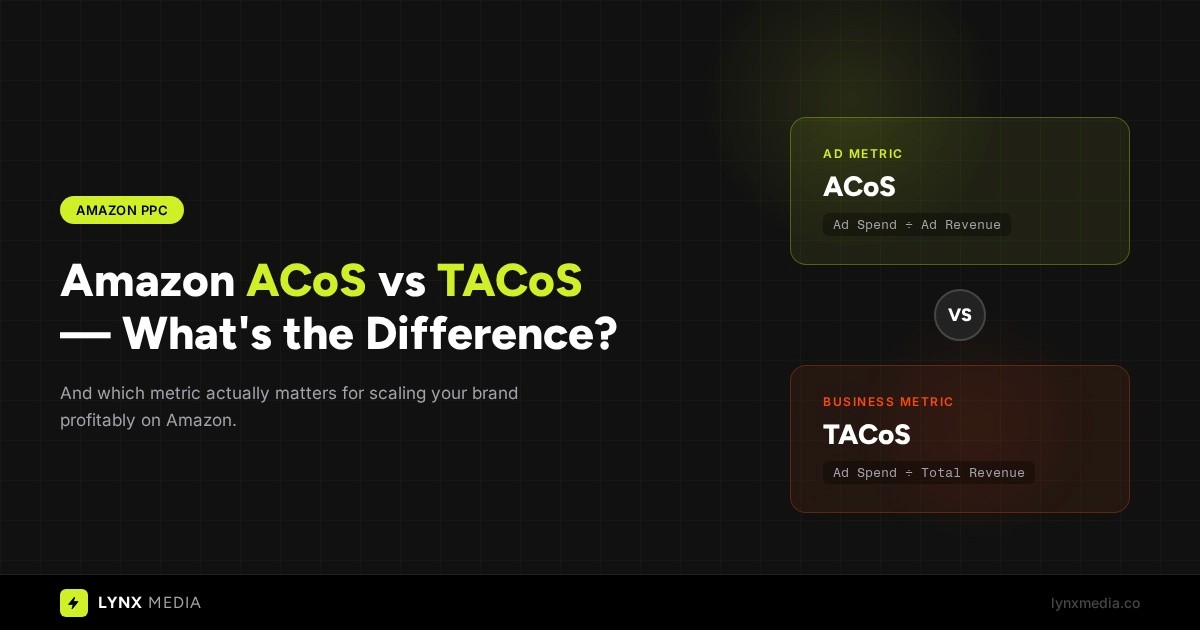
ACoS (%) = (Total Ad Spend / Total Ad Revenue) x 100
Example: $500 ad spend / $2,500 ad revenue = 20% ACoS That means 20 cents of every dollar of ad revenue goes to pay for those ads.
What ACoS Tells You
ACoS shows you how much of every dollar of ad-driven revenue goes to pay for those ads. A 20% ACoS means 20 cents of every dollar of ad revenue is spent on advertising.
ACoS Range | What It Feels Like | What It Actually Means |
|---|---|---|
10-15% | Great | Campaign is efficient at converting ad clicks |
15-25% | Solid | Healthy range for most categories |
25-40% | Concerning | Acceptable during launches; audit if product is mature |
40%+ | Panic | Either pricing, targeting, or listing conversion issue |
When ACoS Is Useful
ACoS works for three specific things: comparing performance between individual campaigns (if one has 25% ACoS and another has 15%, the second converts ad clicks more efficiently), short-term profitability checks (if ACoS exceeds your profit margin, those ads are losing money), and new product launches (when you need visibility fast and accept higher costs to establish traction).
But ACoS has critical blind spots that lead sellers astray. It only accounts for revenue directly attributed to clicks on your ads. It ignores everything else that makes your business profitable — most importantly, organic sales.
What is TACoS (Total Advertising Cost of Sales)? {#what-is-tacos}
TACoS takes a wider view. It measures advertising spend against all revenue your product generates, including organic sales that happen without ads.
The TACoS Formula
TACoS (%) = (Total Ad Spend / Total Revenue) x 100
Example: $500 ad spend / $5,000 total revenue = 10% TACoS That means your ads cost you 10 cents per dollar of all revenue — not just ad revenue.
What TACoS Tells You
TACoS reveals whether advertising is actually helping your overall business profitability. It accounts for the fact that ads do more than generate immediate sales — they boost rankings, establish visibility, and drive long-term organic sales.
This is the metric that answers the question: "Is my advertising budget actually making me more money?"
Why TACoS Is the Better Long-Term Metric
TACoS captures the full picture of your advertising ROI in three ways. First, it accounts for organic sales growth — as your ranking improves from ad volume, more people find you without clicking ads, and TACoS reflects that benefit. Second, it shows true profitability — a 15% TACoS is genuinely excellent, while a 40% TACoS might indicate wasted ad spend regardless of ACoS. Third, it reveals long-term strategy success — sellers focusing on TACoS typically build sustainable, profitable brands, while sellers chasing low ACoS often end up broke.
The best Amazon sellers think in terms of TACoS. They're willing to temporarily run higher ACoS campaigns because they understand it will improve organic rankings and lower overall TACoS over time.
ACoS vs TACoS: Side-by-Side Comparison {#acos-vs-tacos-comparison}
ACoS | TACoS | |
|---|---|---|
Full Name | Advertising Cost of Sales | Total Advertising Cost of Sales |
Formula | Ad Spend / Ad Revenue x 100 | Ad Spend / Total Revenue x 100 |
Measures | Efficiency of paid clicks | Overall advertising ROI |
Best For | Campaign-level optimization | Business profitability & strategy |
Includes Organic? | No | Yes |
Time Horizon | Short-term (daily/weekly) | Long-term (monthly/quarterly) |
Danger If Ignored | Overspending on bad campaigns | Killing organic growth by cutting ads |
Real-World Scenario: Sarah's Vitamin Brand {#real-world-scenario}
Meet Sarah. She sells vitamins on Amazon and has been optimizing for ACoS religiously. Here's her dashboard:
Metric | Value |
|---|---|
ACoS | 30% |
Ad Spend | $2,000/month |
Ad Revenue | $6,667 |
Organic Revenue | $8,000 |
Total Revenue | $14,667 |
TACoS | 13.6% |
Sarah was frustrated by her 30% ACoS. She nearly decided to cut ad spend dramatically to "improve" it.
But look at her TACoS: 13.6% is exceptional. Her ads cost her 13.6 cents per dollar of total revenue. After accounting for COGS, platform fees, and shipping, she's still highly profitable.
More importantly — and Sarah didn't realize this until we explained it — her organic sales were $8,000. Why? Because the $2,000/month in ad spend was boosting her ranking, making her appear in more organic search results, and driving keyword relevance signals that Amazon rewards.
If Sarah had cut ads to "improve" her ACoS, she would have lost ranking momentum, organic sales would have dropped, and her overall profitability would have plummeted.
Key Takeaway: ACoS looked like a problem. TACoS revealed it was actually the engine driving her profitable business growth.
Benchmark Targets for ACoS and TACoS {#benchmark-targets}
Benchmarks vary significantly by category, but here's what we see across the portfolio at LynxMedia:
Good ACoS Targets by Category
Category | Target ACoS | Why |
|---|---|---|
Consumables (vitamins, supplements, household) | 15-25% | Repeat orders justify higher ACoS |
Electronics & high-price items | 10-15% | Lower margins require efficient spend |
Beauty & personal care | 20-30% | Competitive categories with brand loyalty premiums |
Sports & outdoors | 15-25% | Moderate competition |
Warning: If your ACoS is 40%+ and your product has been live for 90+ days, you have one of three problems: a pricing problem (margins are too thin), a targeting problem (ads reaching the wrong audience), or a listing problem (conversion rate is too low).
Good TACoS Targets (Universal)
TACoS Range | Rating | What It Means |
|---|---|---|
Below 15% | Excellent | Highly efficient, profitable advertising |
15-20% | Very Good | Sustainable profitability with room to scale |
20-30% | Good | Healthy, but improving organic rank should be a priority |
30-40% | Needs Attention | Acceptable for launches; audit if product is mature |
40%+ | Red Flag | Ad spend exceeds justified ROI. Audit targeting, bidding, and positioning immediately |
The goal for mature products should be getting TACoS below 25%. Once you hit that, you can grow faster because profitability margins are healthy.
5 Strategies to Lower Your TACoS {#strategies-to-lower-tacos}
Lowering TACoS doesn't require cutting ad spend — sometimes it means spending more strategically to drive the right results.
Strategy 1: Improve Your Organic Rank (The Long-Term Win)
The fastest way to lower TACoS is to improve your organic sales volume. As organic sales grow, your total revenue increases while ad spend stays flat, automatically lowering the percentage.
This happens through increased ad volume (more impressions and clicks establish keyword relevance), higher conversion rate (organic shoppers see your improved ranking and buy more), and better keyword rank (Amazon's algorithm rewards products with consistent sales velocity).
Action Step: Run Sponsored Products ads targeting the keywords you want to rank for organically. Within 60-90 days, you should see organic ranking improvements. Track organic traffic separately in your analytics.
Strategy 2: Optimize Your Listing for Conversions
A 5% increase in conversion rate can lower your TACoS by 2-3 percentage points without changing ad spend at all.
Focus on four areas: your main image (largest file size, clear product photography, lifestyle context), title (include target keyword naturally while highlighting main benefit), bullet points (lead with benefit before features, speak to pain points first), and A+ Content description (address common objections, use social proof).
When your listing converts better, the same ad spend generates more revenue, instantly improving both ACoS and TACoS.
Learn more: Our complete listing optimization guide covers the specific tactics top sellers use to increase conversion rates.
Strategy 3: Use Sponsored Brands for Awareness (Not Just Direct Sales)
Most sellers only measure Sponsored Brands ROI by direct attributed revenue — which makes most Sponsored Brands campaigns look unprofitable. But Sponsored Brands drive brand awareness, increase keyword visibility, and establish your brand in the mind of shoppers. The real value shows up in organic sales over time.
Run Sponsored Brands targeting high-volume keywords in your category. Don't expect breakeven ACoS. Instead, measure success by ranking improvements in target keywords, increase in organic sales, and brand search volume growth (visible in Ads Manager).
Perspective Shift: A Sponsored Brands campaign with 45% ACoS might seem wasteful — until you realize it's responsible for your organic rank improvements and 30% organic sales growth.
Strategy 4: Eliminate Wasted Ad Spend (Negative Keywords & Audience Tuning)
Every dollar spent on the wrong audience is a dollar that lowers your profitability. Audit three things weekly: search term reports (find keywords driving clicks but not sales and add them as negatives), ASIN targeting (if you're targeting competitor products but losing to price, pause those targets), and bid levels (identify keywords where you're bidding too high for conversion rate, lower bids and redirect budget to better performers).
Many sellers lose 15-20% of budget to audience misalignment. Tightening this alone can improve TACoS by 3-5 points.
Go deeper: Amazon PPC management requires ongoing optimization. Audit negative keywords, pause underperformers, and reallocate budget weekly.
Strategy 5: Scale Profitably Through Customer Lifetime Value
The most underrated lever for lowering TACoS is increasing order frequency per customer. For repeat-purchase categories (consumables, supplements, etc.), a customer who buys twice generates 2x revenue from 1x ad spend exposure initially. This dramatically lowers TACoS over time.
Action Step: Implement post-purchase email (via Amazon's email system or off-platform), encourage repeat orders, and track customer lifetime value. A customer acquired for $20 in ad spend who generates $100 lifetime revenue is far more valuable than the original 20% ACoS suggests.
Common Mistakes Sellers Make with ACoS and TACoS {#common-mistakes}
Mistake 1: Treating ACoS as a Profit Metric
ACoS is not profit. A product with 20% ACoS might have 60% COGS, and suddenly your "profitable" campaign is losing money. Always calculate True Profit (Revenue - COGS - Fees - Ad Spend - Other Costs) separately from ACoS.
Mistake 2: Ignoring Organic Sales in the Equation
Some sellers turn off ads entirely because their ACoS is "too high," then watch organic sales plummet. They never realize the ads were supporting their organic ranking. The better approach is to monitor TACoS and organic sales together. If organic sales are growing, higher ACoS might be justified.
Mistake 3: Comparing ACoS Across Campaign Types Without Context
A Sponsored Brands campaign might have 50% ACoS while a Sponsored Products campaign has 18%. This doesn't mean Sponsored Products is "better" — it means they serve different purposes. Sponsored Brands drive awareness and build long-term keyword relevance. Sponsored Products drive immediate conversions. Both contribute to TACoS in different ways.
Mistake 4: Setting a Single ACoS Target for All Products
Your product with 40% margins can support higher ACoS than your product with 15% margins. Set targets based on the economics of each product, not a blanket rule.
Mistake 5: Cutting Ad Spend Before the Strategy Has Time to Work
TACoS improves over time as organic sales accumulate. A new product launch might have 50% TACoS in month one, 35% in month three, and 20% by month six. Don't cut ad spend before allowing time for the strategy to work.
Conclusion: Stop Obsessing Over ACoS, Start Optimizing for TACoS {#conclusion}
ACoS matters for tactical campaign management. TACoS matters for building a profitable, sustainable Amazon business.
The sellers who build 7-figure brands aren't the ones stressing about hitting a specific ACoS number. They're the ones who understand that advertising is an investment in ranking, visibility, and long-term revenue growth — and they measure success by watching TACoS improve over time.
Your next step: Calculate your TACoS for your top 10 products this week. Compare it to your target range. If it's above 30%, it's time to audit your ad strategy, not just cut spend.
Want help lowering your TACoS? Get a free Amazon PPC audit from LynxMedia. Our team has managed $29M+ in Amazon ad spend and knows exactly what's costing you profitability.
Written by the LynxMedia Team — Amazon PPC Management & Strategy Published on lynxmedia.co